

Talented traders lose funding challenges every day, not because they trade poorly, but because they misread a rule or broke a daily loss limit by a few dollars. The evaluation process at firms like FTMO, Topstep, FundedNext, and Apex is strict by design. It filters for discipline, not just skill. If you've failed a challenge before, or you're preparing for your first attempt, this guide walks you through every phase: what to prepare, how to execute, what to verify, and how to avoid the mistakes that quietly eliminate most applicants before they ever see a funded account.
Table of Contents
- What you need before starting a trader funding challenge
- Step-by-step: Completing a prop firm challenge
- Common mistakes and how to avoid them
- Verifying your results and what happens next
- Why process discipline beats talent in prop firm challenges
- Accelerate your funding journey with expert support
- Frequently asked questions
Key Takeaways
| Point | Details |
|---|---|
| Rule discipline is critical | Traders lose challenges mainly from breaking rules, not from lack of trading skill. |
| Pass rates are low | Only 5-10% succeed on their first attempt, so preparation is vital. |
| Automate risk management | Using automated strategies can help maintain consistency and avoid disqualification. |
| Transparent firms matter | Choose established prop firms with clear split structures and reliable payouts. |
What you need before starting a trader funding challenge
Before you register for any evaluation, take a hard look at your setup. The traders who pass consistently treat their preparation phase as seriously as the challenge itself. Skipping this step is one of the fastest ways to waste your entry fee.
Start by comparing the major prop firms. Each one has different rules, account sizes, and profit splits. Here's a quick reference:
| Firm | Market | Profit Split | Max Account | Notable Rule |
|---|---|---|---|---|
| FTMO | Forex | 80-90% split | $2M (scaling) | 10% max drawdown |
| FundedNext | Forex | Up to 90% | $200K | Stellar account option |
| Topstep | Futures | 90% split | $750K | EOD trailing drawdown |
| Apex | Futures | Up to 90% | $300K | Cheapest entry, EOD drawdown |
Established firms with over 10 years of operation have reliable payout histories, which matters when you're choosing where to commit your time and money.
Beyond firm selection, your technical setup needs to be solid. Here's what to have ready:
- Reliable internet connection with a backup option (mobile hotspot at minimum)
- Compatible trading platform: MT4, MT5, or NinjaTrader depending on your firm and market
- Full rulebook printed or saved: daily loss limits, max drawdown, minimum trading days, lot size restrictions
- Risk management calculator: know your position size before every trade
- Trading journal: log every trade from day one
Psychological readiness matters just as much. Funding challenges create artificial pressure. You're watching a balance that can disqualify you permanently if it drops too far. That pressure causes traders to oversize, rush trades, or abandon their strategy entirely. Going in with a written plan for how you'll respond to losing days is not optional. It's part of the process.
Pro Tip: Before your challenge starts, write out every rule in your own words and test yourself on them. Misreading a rule like "trailing drawdown" versus "static drawdown" can end your attempt on day one.
If you want a broader look at evaluating funded trader programs before committing, reviewing multiple firm structures side by side will save you from picking the wrong fit. Automated trading strategies also play a major role here. Algos remove emotional decision-making from the equation, which is exactly what prop firms are testing for.
Step-by-step: Completing a prop firm challenge
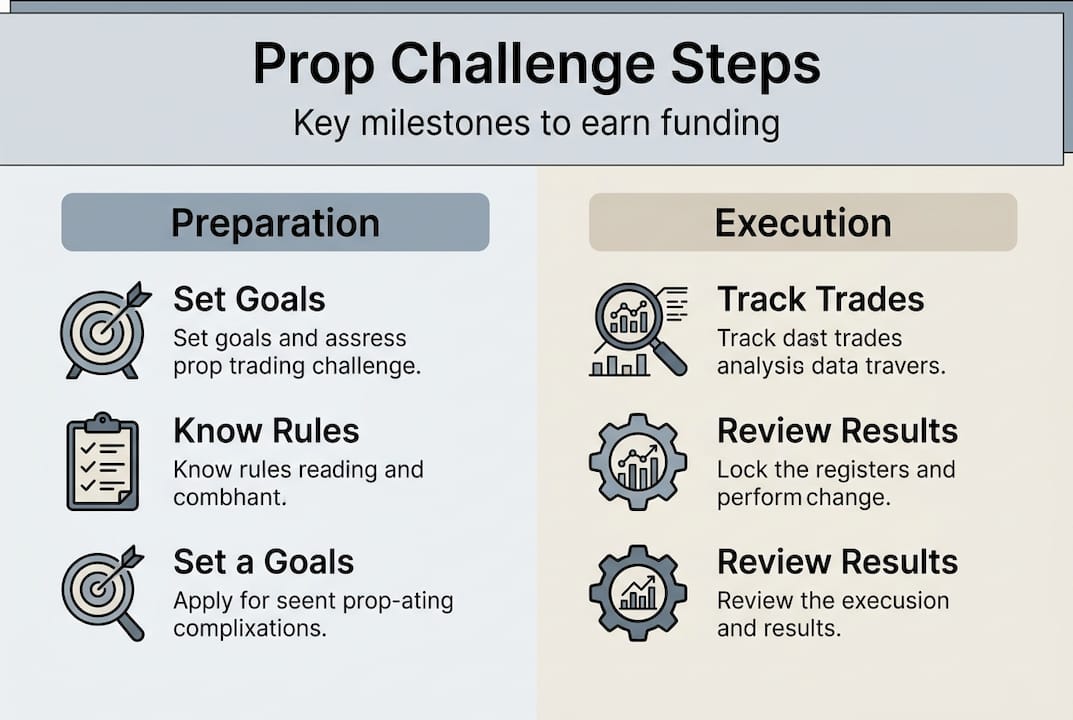
With your preparation checklist complete, you're ready to tackle the challenge itself. Here's how to move through each phase successfully.
Most prop firm evaluations follow a two or three phase structure:
| Phase | Goal | Key Focus |
|---|---|---|
| Evaluation | Hit profit target, avoid drawdown | Consistency and rule adherence |
| Verification | Repeat performance | Prove it wasn't luck |
| Funded account | Trade with firm capital | Scaling and withdrawals |
Here's how to execute each step:
-
Choose your market and platform. Forex traders typically use MT4 or MT5. Futures traders use NinjaTrader or the firm's proprietary platform. Match your existing skill set, not the platform with the most features.
-
Register and read the full rulebook. Not a summary. The full document. Pay special attention to daily loss limits, the type of drawdown used (trailing vs. static), minimum trading days, and any news trading restrictions.
-
Trade the evaluation phase. Focus on hitting the profit target while staying well within drawdown limits. Don't chase the target. Trade your normal strategy and let the results build. Most firms require 5 to 10 minimum trading days, so there's no rush.
-
Complete the verification phase. If required, repeat your performance with the same consistency. Firms are checking that your evaluation wasn't a lucky streak. Smaller, steady gains work better here than aggressive pushes.
-
Submit your performance data for review. Once you've met all targets, the firm reviews your trading history. This is where rule compliance gets audited carefully.
The numbers here are sobering. Industry pass rates sit at just 5 to 10% on the first attempt. FTMO sees roughly 10% pass, Topstep 15 to 20%, and Apex 12 to 18%. Only about 7% of all challengers ever receive a payout. The reason? Rule breaches, not bad trading. Understanding the funded trader evaluation process in detail before you start is what separates the 7% from everyone else.

Common mistakes and how to avoid them
Even the best-prepared traders slip up. Here are the pitfalls to sidestep.
The data is consistent: failures come from rule violations like oversizing trades and revenge trading, not from flawed strategies. That's a critical distinction. Your edge in the market might be real, but it means nothing if you break a rule on day three.
Here are the most common mistakes and what to do instead:
- Oversizing positions: Traders risk too much per trade trying to hit targets faster. Instead, calculate your max position size based on the daily loss limit and never exceed it.
- Revenge trading: After a losing trade, many traders immediately re-enter to recover losses. This compounds the damage. Walk away after a losing session.
- Ignoring daily loss limits: Some traders track overall drawdown but forget the daily cap. Set a hard stop in your platform before each session.
- Missing rule nuances: Trailing drawdown locks in at your highest balance, not your starting balance. Many traders don't realize this until it's too late.
- Trading during restricted periods: Some firms ban trading around major news events. Violating this can void your entire evaluation.
"It's not poor trading strategy, but rule-breaking that wrecks most challenges. The traders who pass treat the rulebook like a trading system in itself."
Pro Tip: Use your platform's built-in alert and limit order tools to automate your risk controls. Set a daily loss alert at 80% of your limit so you get a warning before you hit the wall. This is especially useful if you're running automated strategies during the funded trading challenge tips phase.
Verifying your results and what happens next
After executing your plan and managing risk, it's time to see what your trading performance achieved.
The verification and post-challenge phase is where most traders either celebrate or regroup. Here's the typical process:
-
Submit your performance data. Most firms have an automated dashboard that tracks your results in real time. Once you've met the minimum trading days and profit target without breaching rules, you submit or the system flags you as complete.
-
Receive your verification result. The firm audits your trade history for rule compliance. This usually takes 1 to 5 business days. Be patient. Do not trade impulsively while waiting.
-
Sign the trader agreement. If you pass, you'll receive a funded account agreement outlining your profit split, withdrawal schedule, and scaling plan. Read it fully before signing.
If you pass, the reward is significant. Top forex firms like FTMO offer 80 to 90% profit splits with scaling potential up to $2M. Topstep offers a 90% split on futures accounts up to $750K. These are real numbers that change what's possible for an independent trader.
Transparency in your reporting matters here. Firms that have been operating for over a decade have reliable payout processes, but you still need to track your own metrics. Keep records of every trade, every withdrawal request, and every communication with the firm.
If you fail, treat it as a data collection exercise. Review your trade log and identify exactly which rule you broke or which session caused the most damage. Most traders who eventually get funded have failed at least once. The funded trading process insights you gather from a failed attempt are often more valuable than any course.
When you do get funded, start conservatively. Scale your position sizes gradually as your account grows. The goal in the first month is to prove consistency, not to maximize withdrawals.
Why process discipline beats talent in prop firm challenges
Here's something most trading content won't tell you: raw talent is nearly irrelevant in a prop firm challenge. We've seen traders with genuinely impressive market reads fail repeatedly while methodical, process-driven traders with average strategies pass on the first try.
Funding challenges are not market tests. They're discipline tests. The profit target exists to confirm you can generate returns. The drawdown rules exist to confirm you won't blow up. The minimum trading days exist to confirm you're not gambling on one lucky trade. Every rule is measuring your ability to follow a system under pressure.
The traders who struggle most are often the ones with the most confidence in their strategy. That confidence makes them bend rules. They think, "I know this trade is right," and they oversize. Or they take a trade during a restricted news window because they're certain of the outcome. Certainty is dangerous in a challenge environment.
What works is obsessive rule adherence combined with automated risk controls. Use algos or platform tools to enforce your limits so that emotion can't override them. Treat the rulebook as your primary trading system and your market strategy as secondary. Review trader discipline insights regularly to reinforce this mindset. The traders who get funded and stay funded are the ones who figured this out early.
Accelerate your funding journey with expert support
If you want to improve your odds even further, consider leveraging premium support from people who have already navigated this process.

At JPTradingCapital, we specialize in helping traders pass prop firm challenges with verified, transparent strategies. Whether you need automated trading tools, hands-on evaluation prep, or access to professional trading services built around firms like FTMO, Topstep, FundedNext, and Apex, we've got you covered. Our team uses real-time performance tracking and risk-managed algos to give you every advantage. Explore our detailed trader funding guides to go deeper on any phase of the process and connect with a community of serious funded traders who are already making it work.
Frequently asked questions
What is the average pass rate for prop firm trader funding challenges?
Industry pass rates sit at just 5 to 10% on the first attempt, and only about 7% of all challengers ever receive a payout, making preparation and rule adherence critical.
How do funded trading challenges typically work?
You pass an evaluation by hitting a profit target while following strict rules and staying within drawdown limits, then gain access to a funded account with a profit split of 80 to 90% at top firms.
Why do most traders fail to get funded?
Most failures come from rule violations like oversizing positions and revenge trading after losses, not from weak trading strategies or poor market analysis.
What happens after you pass a trading challenge?
You sign a trader agreement and gain access to a funded account with a profit-sharing structure. Top firms like FTMO offer 80 to 90% splits with scaling potential up to $2M.