

Fewer than 10% of traders who attempt prop firm challenges ever see a payout, yet the industry continues to attract thousands of serious traders every month. That gap between ambition and outcome isn't random. Most traders enter evaluations without a clear picture of how prop trading actually works, what firms are really measuring, and where the hidden failure points live. This guide cuts through the noise. You'll get a clear breakdown of how prop firms operate, the real numbers behind industry pass rates of 5 to 15%, and the specific strategies that separate funded traders from the majority who wash out.
Table of Contents
- What is prop trading? The institutional vs. retail split
- How the retail prop firm challenge process works
- Inside the numbers: Success rates, payouts, and common pitfalls
- How to approach prop firm challenges like a professional
- What most guides miss about retail prop trading
- Explore funding options with JPTradingCapital
- Frequently asked questions
Key Takeaways
| Point | Details |
|---|---|
| Low pass rates | Only 5-15% of traders pass prop firm challenges and even fewer receive payouts. |
| Rule adherence is critical | Success comes from consistently following risk and challenge rules, not just aiming for profit. |
| Understand the challenge model | Retail prop trading relies on pay-to-enter challenges, simulated accounts, and strict evaluation rules. |
| Transparency matters | Choose firms with clear payout data, transparent rules, and strong community reputations. |
What is prop trading? The institutional vs. retail split
Prop trading, short for proprietary trading, means a firm deploys its own capital in the markets rather than managing money on behalf of clients. The firm keeps the profits, absorbs the losses, and sets the rules. That's the core definition. But the word "prop trading" now covers two very different worlds, and confusing them is one of the most common mistakes new traders make.
Traditional institutional prop trading happens inside banks, hedge funds, and dedicated trading firms. Traders at these firms receive salaries, bonuses, and access to real firm capital. They typically run quantitative strategies, work in office environments, and are hired based on track records and credentials. The barrier to entry is high, and the stakes are real in every direction.
Retail prop trading is a different animal entirely. According to Alphaex Capital, prop trading involves firms trading with their own capital rather than client funds, rewarding traders with profit splits of 80/20 or better while enforcing strict risk limits like daily drawdown caps of 3 to 5% and maximum drawdown limits of 6 to 10%. In the retail model, however, the capital is often simulated, and the path in is through a paid evaluation.
Here's how the two models compare side by side:
| Feature | Institutional prop trading | Retail prop trading |
|---|---|---|
| Capital type | Real firm capital | Often simulated/virtual |
| Entry method | Hiring process | Paid challenge evaluation |
| Compensation | Salary + bonus | Profit split (70 to 90%) |
| Risk limits | Internal firm policy | Published rules (daily/max drawdown) |
| Accessibility | Very limited | Open to any trader globally |
| Failure consequences | Job loss | Lost challenge fee |
As Alphaex Capital notes, institutional prop trading uses real firm capital with salaries and quant strategies, while retail prop trading is challenge-based, fee-driven, often simulated, and carries high failure rates. That distinction matters because it reframes your mindset entirely. You're not applying for a job. You're proving a system works under controlled conditions.
"The retail prop firm model democratizes access to trading capital, but it also shifts all the risk of the evaluation onto the trader. Understanding that dynamic is the first step to approaching it strategically."
For more prop firm challenge insights on how these models play out in practice, it's worth studying how top firms structure their rules before you pay a single dollar.
How the retail prop firm challenge process works
The retail prop firm challenge process follows a predictable structure, but the details inside that structure are where most traders get caught. Knowing the mechanics cold before you start is non-negotiable.
The typical evaluation runs in two phases. Phase one is the main challenge, where you must hit a profit target, usually 8 to 10% of the account size, without breaching daily or maximum drawdown limits. Phase two is the verification stage, a shorter period with a lower profit target (often 5%) designed to confirm your phase one results weren't a fluke. Pass both, and you receive a funded account with a profit split.
According to Alphaex Capital, modern retail prop firms use a challenge model where traders pay a fee in the range of $100 to $500 for a $50,000 account to pass one or two phase evaluations with profit targets, drawdown limits, and consistency rules such as no single day exceeding 40% of your total profit. Passing earns you a simulated or live funded account with a profit split.

Here's a breakdown of what typical challenge parameters look like:
| Parameter | Typical range |
|---|---|
| Challenge fee | $100 to $500 |
| Account size | $25,000 to $200,000 |
| Phase 1 profit target | 8 to 10% |
| Phase 2 profit target | 4 to 5% |
| Daily drawdown limit | 3 to 5% |
| Maximum drawdown limit | 6 to 10% |
| Profit split (funded) | 70 to 90% |
To approach the challenge phase and funding process with confidence, follow these steps in order:
- Read the firm's full rulebook before placing a single trade. Every firm has nuances.
- Set your position sizing so that your worst expected loss on any day stays well inside the daily drawdown limit.
- Build a trading journal from day one. Document every trade with the rationale and outcome.
- Treat the verification phase as seriously as the challenge. Many traders relax and fail here.
- Understand the payout schedule before you're funded. Know when and how you'll get paid.
Pro Tip: Treat the challenge fee as tuition, not a lottery ticket. If you can't explain why every trade fits your system and the firm's rules, you're not ready to pay that fee yet.
Inside the numbers: Success rates, payouts, and common pitfalls
The statistics around prop firm challenges are sobering, and every serious trader should know them before committing capital to an evaluation.
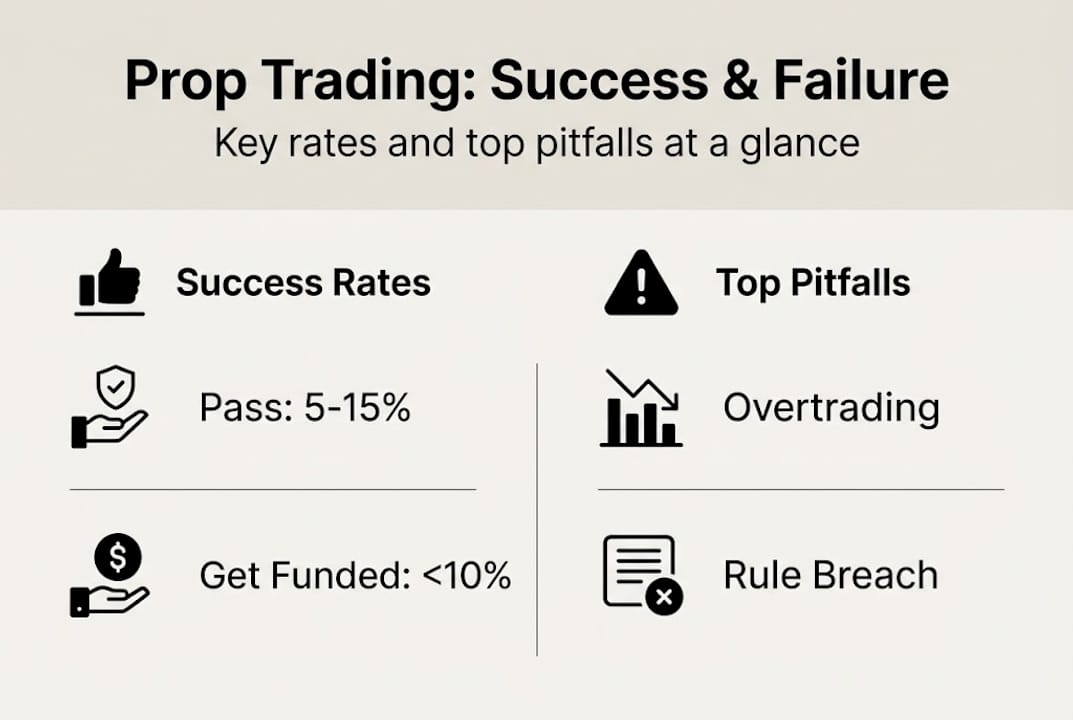
Pass rates across the industry sit between 5% and 15%. FTMO's pass rate runs roughly 10 to 12%, Apex lands between 12 and 20%, and the broader industry average hovers around 5 to 10%. Only about 7% of all traders ever receive a payout. Apex alone has paid out $598 million to traders since 2022, which confirms that real money flows to the small percentage who get it right.
Those numbers tell a clear story. The challenge model is not rigged against you, but it is brutally unforgiving of undisciplined trading. Here are the most common failure points:
- Breaching the daily drawdown limit: A single bad session wipes the entire attempt, regardless of how well you traded before it.
- Overtrading to hit profit targets: Traders who chase the target in the final days take oversized positions and blow the account.
- Ignoring consistency rules: Some firms cap how much of your total profit can come from a single day. Traders who don't read this rule fail without understanding why.
- Trading during restricted news events: Many firms prohibit holding positions through major economic releases. Missing this in the fine print is an instant disqualification.
- Emotional revenge trading: A losing streak triggers a cycle of larger, riskier trades that accelerate the drawdown.
The prop trading industry stats make one thing clear: the traders who pass are not necessarily the most talented. They are the most disciplined and the most rule-aware.
Pro Tip: Set a personal daily loss limit at 50 to 60% of the firm's official limit. If you hit your internal limit, you stop trading for the day. This buffer protects you from the worst-case scenario and keeps the account alive.
How to approach prop firm challenges like a professional
With the reality of the numbers in focus, here's how serious traders shift the odds in their favor. It starts with a mindset reset: your job during a challenge is not to make money. Your job is to not break the rules while making money. That reframe changes every decision.
Rule-first trading means you build your position sizing, session schedule, and trade selection entirely around the firm's constraints. You don't trade a strategy and then check if it fits the rules. You design your approach around the rules from the start.
Automation and data-driven execution are becoming standard tools for serious challenge traders. Algorithms don't overtrade out of frustration. They don't hold a losing position hoping for a reversal. Automating your prop trading strategy removes the emotional layer that kills most manual traders during high-pressure evaluation periods. Even a semi-automated approach, where an algorithm handles entry and exit while you monitor, dramatically reduces impulsive decisions.
Here's a professional approach framework in sequence:
- Backtest your strategy against at least 12 months of data before starting any challenge.
- Define your maximum daily trade count. Overtrading is a volume problem as much as a skill problem.
- Set hard stops in your platform that mirror the firm's drawdown limits exactly.
- Review your journal weekly. Look for patterns in your losing trades, not just your winners.
- Join a trading community where other challenge traders share real-time experiences and rule interpretations.
The community angle is underrated. Reddit discussions on prop firm challenges highlight that while some traders criticize the fee-driven model, established firms like FTMO and Apex pay reliably, and success requires rule-first trading over profit-chasing. The traders who engage with communities, share their metrics, and learn from others' mistakes consistently outperform those who go it alone.
Key mindset traits that funded traders consistently demonstrate:
- Patience: They don't force trades when conditions don't match their criteria.
- Self-review discipline: They analyze losses without ego and adjust without overreacting.
- Process orientation: They measure success by rule adherence first, profit second.
What most guides miss about retail prop trading
Most content about prop trading focuses on tactics: which indicators to use, which firms to pick, how to hit the profit target faster. That's useful, but it misses the deeper challenge that trips up even technically skilled traders.
The psychological weight of strict rule enforcement is genuinely different from normal trading. When a single session can end a weeks-long attempt, the pressure distorts decision-making in ways that are hard to simulate in practice. Traders who perform well in demo environments often underperform in challenges because the stakes feel real even when the capital is simulated.
Another overlooked failure mode is documentation and rule interpretation. Many traders fail not because their trading was bad but because they misunderstood a specific rule, missed a news restriction, or failed to meet a minimum trading day requirement. These are non-performance failures, and they're entirely preventable with careful preparation.
Transparency around firm policies is the most reliable signal of a firm's legitimacy. Firms that publish payout histories, clear drawdown rules, and verifiable trader testimonials give you real data to assess your actual odds. Chasing the highest profit split or the fastest evaluation timeline is a distraction. What matters is building a deep dive on prop trading realities into your preparation, understanding exactly what the firm expects, and developing a systematic process that you can repeat across multiple attempts if needed. Fast profits are a side effect of a good process, not the goal itself.
Explore funding options with JPTradingCapital
If you've read this far, you're already thinking about prop trading more seriously than most. Knowing the rules, the statistics, and the professional approach puts you ahead of the majority who walk in blind.

At JPTradingCapital, we specialize in exactly this space: transparent challenge passing, automated trading strategies, and trade copying across top-tier firms including FTMO, FundedNext, FXify, TopStep, and Apex. Our platform gives you real-time performance tracking, verified payout histories, and a community of traders who share the same goal. Whether you want to automate your challenge strategy or explore trader insights from JPTradingCapital, we've built every tool around the principle that funded trading should be transparent, systematic, and repeatable.
Frequently asked questions
How does retail prop trading differ from institutional?
Institutional firms deploy real capital and pay traders salaries and bonuses, while retail prop firms offer simulated funded accounts through pay-to-enter challenge evaluations with profit splits.
What is the typical pass rate for prop firm challenges?
Industry pass rates range from 5% to 15% depending on the firm, with fewer than 10% of all challenge participants ever receiving a payout.
How much does it cost to take a typical prop trading challenge?
A $50,000 challenge account typically costs between $100 and $500, with the fee varying based on the firm, account size, and number of evaluation phases.
What are the most common reasons traders fail prop firm evaluations?
Most traders fail by breaching daily drawdown limits, overtrading near the end of the evaluation period, or misunderstanding a rule that leads to disqualification. Rule-first trading is the most reliable path to passing.
Are retail prop trading firms scams?
Reputable firms are not scams. FTMO and Apex pay reliably to traders who pass evaluations, and Apex has paid $598M since 2022, which is verifiable evidence that the model works for disciplined traders.