
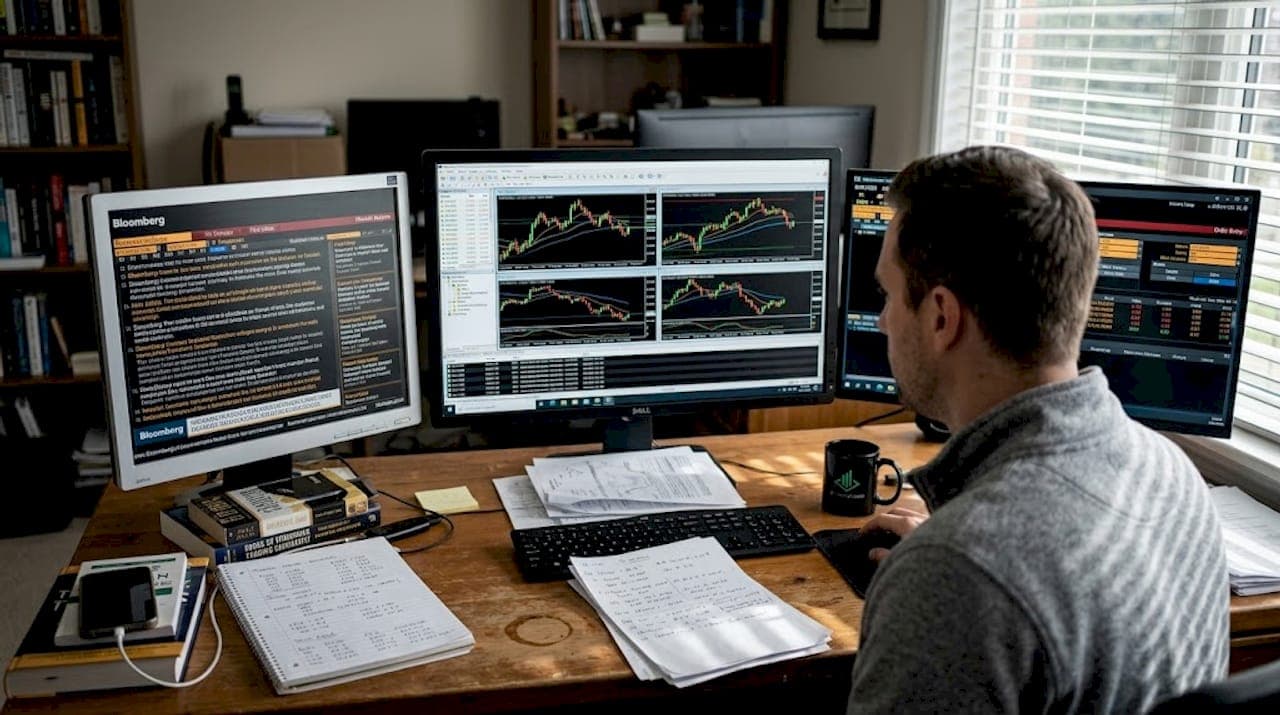
Serious forex and futures traders know the frustration of watching a perfect setup slip by because hesitation crept in at the wrong moment. Or worse, watching a winning trade turn into a loss because emotion overrode the plan. Manual trading demands constant attention, iron discipline, and superhuman consistency. Automated trading solves these problems at the root. By replacing human decision-making with rule-based algorithms, you get a system that executes without fear, fatigue, or second-guessing. For traders working toward funded accounts with firms like FTMO, FundedNext, or Apex, the advantages go even further. Here is what automation actually delivers.
Table of Contents
- Increased consistency and reduced emotions
- Better risk management and faster execution
- Scalability and opportunity capture
- Performance tracking and transparency
- The truth most experts miss about automation
- Take your trading further with automation
- Frequently asked questions
Key Takeaways
| Point | Details |
|---|---|
| Consistency advantage | Automated trading removes emotion, ensuring every trade follows your system. |
| Superior risk control | Systems can instantly apply risk parameters across many trades, protecting your capital. |
| Scalability and opportunity | Automation lets you manage more markets and never misses a trading chance. |
| Data-driven improvement | Automated logs enable deep analysis and faster refinement of your trading strategies. |
| Preparation is crucial | The best results come from well-tested, thoughtfully designed automated systems. |
Increased consistency and reduced emotions
Emotional trading is one of the biggest account killers in forex and futures. You know the pattern: you move a stop-loss because you "feel" the trade will recover. You skip a valid signal because the last three trades lost. You oversize a position after a big win. These are not strategy problems. They are human problems. And they cost real money.
Automated systems do not feel fear or greed. They execute the same logic on trade number one as they do on trade number one thousand. That consistency is not just a comfort feature. It is a performance edge. When your algorithm fires a signal, the order goes in immediately, at the right size, with the correct stop and target already set. No hesitation. No second-guessing.
For funded account traders, this matters even more. Prop firms like TopStep and Apex enforce strict drawdown limits and rule sets. One emotional trade can end a challenge. Automation removes that risk entirely by keeping execution aligned with your rules at all times.
Key ways automation improves consistency:
- Removes discretionary override from trade entries and exits
- Applies identical position sizing rules across every trade
- Executes stop-loss and take-profit orders without delay
- Prevents overtrading during losing streaks
- Keeps trading behavior aligned with the funded account ruleset
"Discipline is not about willpower. It is about building systems that make the right action the only action."
Research backs this up. Automated strategies outperform manual approaches on a risk-adjusted basis, particularly in volatile emerging market conditions where emotional decision-making tends to break down fastest.
Pro Tip: Before going live, explore the benefits of backtesting your system across multiple market conditions. A strategy that only works in trending markets will fail during consolidation, and you need to know that before real capital is at stake.
Better risk management and faster execution
While consistency and discipline provide a strong foundation, risk management and quick execution set automated trading apart, especially under pressure. In fast-moving forex and futures markets, speed is not just an advantage. It is survival.
Manual traders face a brutal reality: by the time you see a signal, decide to act, and place the order, the market has already moved. Slippage eats into your edge. In high-frequency environments, even a one-second delay can mean the difference between a filled order at your price and a filled order significantly worse.

Automated systems eliminate this delay entirely. Orders fire in milliseconds based on preset criteria. Stop-losses trigger without hesitation. Take-profit levels close positions at exactly the right moment. There is no "I will just wait a little longer" behavior that bleeds profits.
Here is how automated execution improves risk management step by step:
- Signal detection: The algorithm scans market data continuously and identifies valid setups based on your rules.
- Order placement: The trade fires instantly, at the exact entry price defined by your logic.
- Stop-loss activation: Risk parameters are set at the moment of entry, not adjusted emotionally afterward.
- Position monitoring: The system tracks multiple open positions simultaneously without cognitive overload.
- Exit execution: Profit targets and trailing stops close trades at the right time, every time.
Prop firms require traders to stay within daily loss limits and maximum drawdown thresholds. Automation enforces these rules mechanically. Risk control strategies built into your algorithm mean you never accidentally blow through a funded account limit because you were tired or distracted.
"The fastest way to lose a funded account is not a bad strategy. It is good strategy executed badly under pressure."
Automated systems also handle multi-position management that would overwhelm any manual trader. Running five correlated forex pairs simultaneously while monitoring two futures contracts is not realistic by hand. Algorithms do it without breaking a sweat.
Scalability and opportunity capture
With strong risk management in place, automation opens the door to much greater trading capacity. This is where serious traders start to see the real leverage that algorithms provide.
Manual trading has a hard ceiling. You can only watch so many charts, process so many signals, and execute so many trades before performance degrades. Your brain gets tired. Your focus drifts. Opportunities get missed. Algorithms have no such ceiling.
A well-designed automated system can monitor dozens of instruments across forex, futures, and commodities simultaneously. It can scan global markets during the Asian session, the London open, and the New York close without ever needing sleep. For traders chasing funded account scaling plans, this is a game-changer.
AATS backtested on EM portfolios demonstrate scalable advantages over buy-and-hold strategies, showing that systematic approaches can be applied broadly without losing their edge.
| Feature | Manual trading | Automated trading |
|---|---|---|
| Markets monitored | 1 to 3 | 10 to 50+ |
| Time coverage | Limited to waking hours | 24/7 across all sessions |
| Execution error rate | Moderate to high | Very low |
| Strategy consistency | Variable | Constant |
| Scalability | Low | High |
Scalability also means you can run multiple strategies at once. A trend-following system on EUR/USD, a mean-reversion algo on NQ futures, and a breakout strategy on crude oil can all operate in parallel without conflict, as long as your risk parameters account for correlation.
For traders working toward developing automated trading systems that can handle multiple funded accounts, this parallel capacity is essential. Prop firms reward consistent, scalable performance. Automation is the only realistic path to delivering it.
- Monitor forex, futures, and commodities simultaneously
- Capture overnight and off-hours moves without manual oversight
- Run multiple non-correlated strategies in parallel
- Scale funded account performance without proportionally scaling effort
Performance tracking and transparency
Now that you have seen how automation expands your reach, let us talk about how it makes measuring progress and accountability easier. This is one of the most underrated benefits of systematic trading.
Every trade an automated system executes gets logged. Entry price, exit price, time in trade, position size, profit or loss, slippage, and dozens of other data points are recorded automatically. You never have to wonder what happened or why. The data tells the story.
For funded account traders, this transparency is not just useful. It is required. Prop firms need clean audit trails to verify compliance with their rules. Automated systems produce these records as a natural byproduct of operation. No manual journaling, no reconstructing trades from memory, no gaps in the record.
Automated trading performance can be measured across thousands of trades, giving you statistical confidence in your results that no manual trader can match.
| Metric | Automated tracking | Manual tracking |
|---|---|---|
| Trade log completeness | 100% automatic | Dependent on discipline |
| Performance analysis depth | Thousands of trades | Dozens to hundreds |
| Compliance audit readiness | Instant | Time-consuming |
| Pattern identification | Algorithm-assisted | Manual review |
| Optimization speed | Fast, data-driven | Slow, subjective |
The ability to analyze results at scale changes how you improve. Instead of guessing why your win rate dropped last month, you pull the data and find out exactly which market condition caused the issue. You fix it, retest, and redeploy. That feedback loop is what separates traders who grow from traders who plateau.
Exploring the importance of data in trading will show you just how much performance improvement comes from systematic analysis rather than intuition.
Pro Tip: Review your trade logs every week. Look for patterns in losing trades, such as specific times of day, market conditions, or instrument types that consistently underperform. Small adjustments based on real data compound into major performance gains over time.
The truth most experts miss about automation
With all these benefits laid out, it is important to address a key misconception about automation. Most traders hear "automated trading" and picture a magic system that prints money while they sleep. That is not what automation is.
Automation is a force multiplier. It takes whatever trading logic you give it and executes it faster, more consistently, and at greater scale than any human could. If that logic is sound, automation amplifies your edge. If that logic is flawed, automation amplifies your losses. The system does not know the difference.
We have seen traders automate losing manual strategies and then wonder why their drawdown accelerated. The algorithm did exactly what it was told. The problem was the instruction, not the execution.
The traders who get the most from automation invest serious time in system design best practices before they ever run live. They backtest rigorously. They stress-test across different market regimes. They understand why their strategy works, not just that it works. That foundation is what makes automation powerful rather than dangerous.
Automation rewards preparation. It does not replace it.
Take your trading further with automation
If you are ready to integrate these automated advantages into your trading approach, JPTradingCapital is built for exactly this.
JPTradingCapital provides automated trading solutions designed for serious forex and futures traders working toward funded accounts with top-tier prop firms. From algo strategy development to trade copying and challenge passing support, the platform gives you the tools and expertise to trade systematically and transparently. Whether you are building your first automated system or scaling an existing one, the team at JPTradingCapital can help you align your approach with the strict requirements of funded trading programs. Connect with the community, access real-time performance data, and take the next step toward trading with confidence and consistency.
Frequently asked questions
What is automated trading and how does it work?
Automated trading uses software algorithms to execute trades based on predefined rules without human intervention. The system monitors the market, identifies signals, and places orders automatically according to your strategy logic.
Can automated trading actually outperform manual trading?
Yes. Automated strategies outperform manual approaches on a risk-adjusted basis, particularly in volatile markets where emotional decision-making tends to produce inconsistent results.
Is automated trading suitable for funded accounts?
Automated trading is well-suited for funded accounts because it enforces the strict risk limits and rule compliance that funded trading programs require, removing the human error that most commonly causes challenge failures.
What is the primary risk of automated trading?
Automation amplifies whatever logic drives it, so poor system design or an untested strategy can lead to accelerated losses. Rigorous backtesting and ongoing performance review are essential before and after deployment.